
Qingyun Dan Lab | Johns Hopkins University
Synthetic Biology and Natural Products
Unleash nature’s power for a greener and sustainable future.
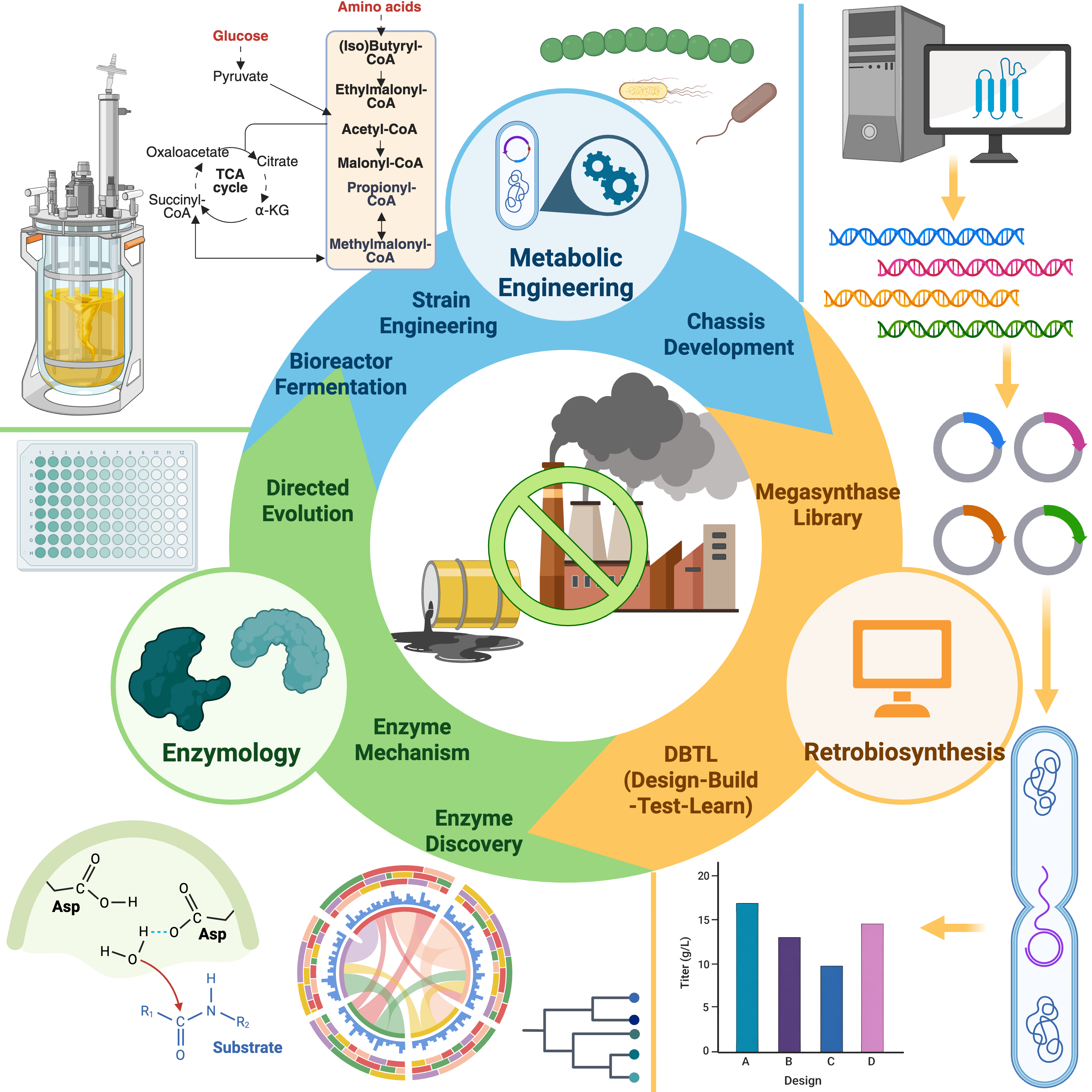
Replacing petrochemical synthesis with biomanufacturing 
Fungal indole alkaloid biogenesis through evolution of a bifunctional reductase/Diels–Alderase 
Polyketide synthase-based controlled synthesis of polycyclopropanated fuel molecules 
A polyketide-based biosynthetic platform for diols, amino alcohols and hydroxy acids 
Go blue jays!
Welcome to the Dan lab @ JHU ChemBE!
In this lab, using integrative technologies in metabolic engineering, enzymology, structural biology, automated computational design and AI-based enzyme evolution, we engineer microbes to make useful molecules.
Our society urgently requires a transition from fossil fuel dependence to a biosustainable economy. Petroleum-based chemical synthesis is critical for fueling societal development, producing more than 100,000 industrial molecules and a market size of 2 trillion USD, but it also accounts for 20% of global industrial CO₂ emissions. Scientists have long dreamed of replacing petrochemical synthesis with biomanufacturing. However, most petrochemicals for daily use are new-to-nature molecules without any natural biosynthetic route, so establishing a biomanufacturing platform capable of biosynthesizing large numbers of new-to-nature molecules is key to our success.
Modular polyketide synthases (PKSs) and nonribosomal peptide synthetases (NRPSs) are megasynthases that produce complex natural product pharmaceuticals in an assembly-line manner. Within each functional module, the chemical structure of the product is strictly determined by the order of its enzymatic domains. A single megasynthase can contain hundreds of domains, creating a vast chemical design space. We envision engineering PKS/NRPS systems to replace petroleum-based chemical synthesis and enable the production of virtually any organic molecule. By establishing such retrobiosynthetic platforms integrated with automated computational design frameworks, we aim to produce a broad spectrum of specialty and commodity chemicals in engineered host microorganisms.

Retrobiosynthesis
Use computational tools to overcome the challenges of biosynthetic pathway design in engineered microorganisms.
Enzymology
Integrate the logic of designing PKSs for carbon backbone assembly and tailoring enzymes for functional group installation.

Metabolic Engineering
Systematically harness host microbes for high-throughput tests of thousands of newly designed pathways.
Maryland Hall Room 122
3400 N. Charles Street
Baltimore, MD 21218
Department of Chemical and Biomolecular Engineering
Whiting School of Engineering
Johns Hopkins University